
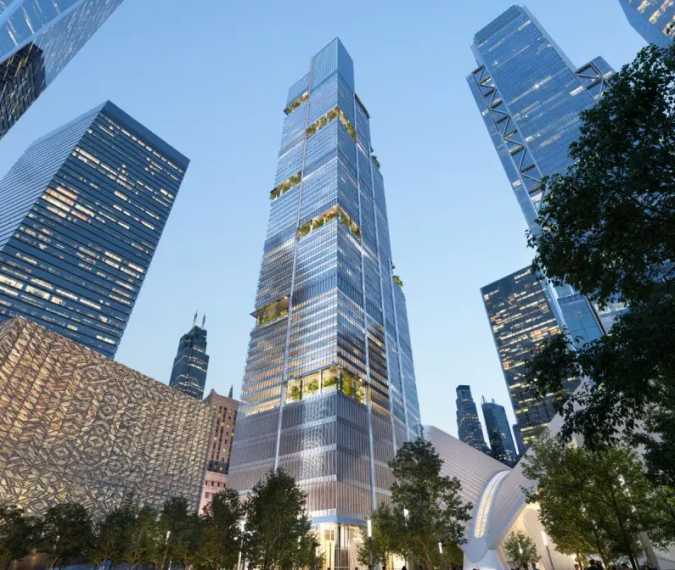
25 years after 9/11, the World Trade Center’s last tower finally rises
For travelers exploring Lower Manhattan, the World Trade Center tells a story that is still unfolding. As New York marks 25 years since September 11, construction of 2 World Trade Center brings the redevelopment closer to a milestone decades in the making: completing the site’s final planned commercial office tower.
The building will become American Express’s new global headquarters at 200 Greenwich Street, just north of the Oculus. Its arrival will add another major landmark to a neighborhood where remembrance, architecture and everyday city life share the same streets.
Designed by Foster + Partners, the tower is planned to contain nearly two million square feet across 55 floors, with room for up to 10,000 employees. Completion is expected in 2031. Among its defining features will be more than an acre of outdoor terraces and gardens, bringing greenery into the building’s upper levels. These spaces are described as part of the workplace design; visitors should not assume they will be public attractions.
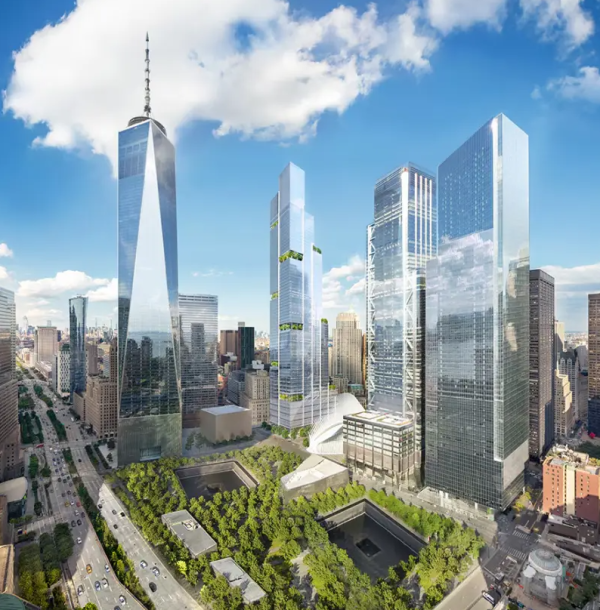
Photo: Courtesy of American Express
American Express plans to own and occupy the building, while the Port Authority retains ownership of the land. The move will keep the company in the neighborhood it has called home for generations. Its existing headquarters at nearby 200 Vesey Street opened in 1986 and will remain in use until the new building is ready.
Behind the construction is a rebuilding effort that has occupied much of developer Larry Silverstein’s later life. He acquired the lease on the original World Trade Center just weeks before the attacks. Now 95, he continues working from 7 World Trade Center, according to reporting by The New York Post.
The long wait for 2 World Trade Center reflects the difficulty of rebuilding on this scale. Insurance disputes, financing requirements, and coordination between public agencies all complicated progress. Other office buildings had to establish the site’s commercial appeal before the remaining tower could move forward. American Express’s commitment supplied the certainty the project needed.
Some of the least visible work was already complete. The Post reports that excavation and foundation construction finished in 2013 alongside work associated with the Oculus. This summer’s groundbreaking therefore marked a new phase of a project whose groundwork had been in place for years.
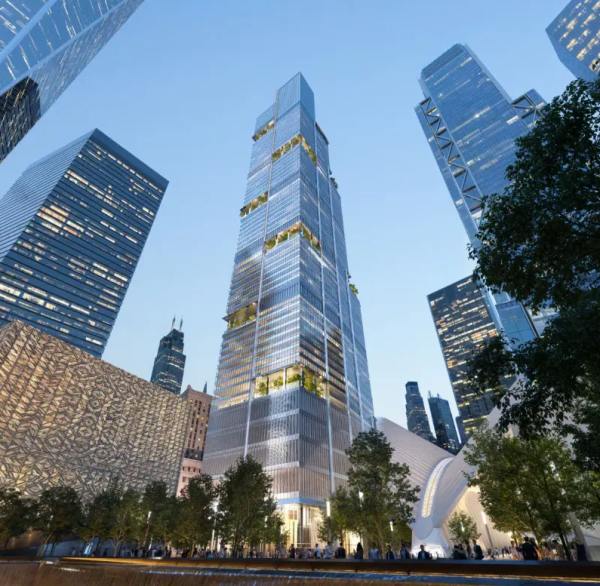
Photo: Courtesy of American Express
For visitors, the tower adds context to the architecture surrounding the September 11 Memorial. Daniel Libeskind’s 2003 master plan placed remembrance at the center of the redevelopment. According to Silverstein Properties executive Dara McQuillan, interviewed by The Post, office entrances face the memorial, while more commercial activities are directed toward neighboring streets.
That relationship gives the district a particular character: a place of mourning remains central to a functioning neighborhood of offices, transit connections and public spaces. Seeing the area through that lens offers more than a checklist of buildings to photograph.
Even when 2 World Trade Center opens, another development question may remain. The separate residential project at 5 World Trade Center has faced financing difficulties and rising construction costs. The Post reports that plans envision roughly 1,200 homes, with the Port Authority still aiming to make one-third affordable, but no firm construction timeline.
The distinction matters: 2 World Trade Center is the final planned commercial office tower, rather than the final piece of every development at the site.
For anyone returning to New York over the coming years, its construction will offer a visible measure of change. The skyline continues to evolve around a memorial that anchors the neighborhood to its history.

